Cape Coral AC diagnostics + repair
AC Repair Cape Coral FL
Find the problem. Fix the cooling.
This site is built for Cape Coral homeowners working through a cooling failure: a system that isn't cooling, air coming out warm, water pooling at the air handler, ice on the refrigerant lines, a unit that short cycles, or one that won't start at all. Each symptom has its own page explaining the likely causes, the safe checks you can make yourself, and the point where the equipment needs a technician.
What is your AC doing?
Location
Cape Coral, Lee County FL
Focus
Residential cooling repair
Phone
239-423-5617
Approach
Diagnostic first
Diagnostic selector
What is your AC doing?
Six failure patterns cover most residential cooling calls. Match what you're seeing, read the likely causes, then decide whether it's something you can check or something that needs test equipment.
06 modules
AC not cooling
SymptomSystem runs, thermostat never satisfies, rooms stay warm.
CausesLoaded filter, frozen coil, low refrigerant charge, dirty condenser coil, failed capacitor.
Read the guide 02AC blowing warm air
SymptomSupply registers deliver air at or above room temperature.
CausesOutdoor unit not running, tripped breaker, contactor or capacitor failure, refrigerant loss.
Read the guide 03AC not turning on
SymptomNothing responds when the thermostat calls for cooling.
CausesTripped breaker, blown low-voltage fuse, float switch open, failed transformer or thermostat.
Read the guide 04AC leaking water
SymptomWater at the air handler, wet ceiling, or a full drain pan.
CausesClogged condensate line, algae growth, disconnected drain, frozen coil melting off.
Read the guide 05Frozen AC
SymptomIce on the indoor coil, copper line set, or outdoor service valves.
CausesRestricted airflow, weak blower, closed returns, refrigerant undercharge from a leak.
Read the guide 06AC short cycling
SymptomSystem starts and stops every few minutes without cooling the house.
CausesThermostat placement or fault, low charge, dirty coil, electrical control problem, oversizing.
Read the guideLocal conditions
AC repair in Cape Coral is different
Cooling equipment in Southwest Florida works under conditions most of the country never sees. The cooling season here runs most of the calendar rather than a few months, so compressors, blower motors, contactors and capacitors accumulate runtime hours far faster than the same parts would in a northern climate. Wear-related failures arrive earlier as a result.
Humidity changes the job as much as heat does. A Cape Coral system spends a large share of its capacity removing moisture, not just lowering temperature. That produces a steady stream of condensate all season, which is why drain line restrictions and overflowing pans are such a common failure here. It also means airflow problems escalate quickly: a coil already handling a heavy moisture load will ice over sooner when a filter loads up or a return gets blocked.
Outdoor units live a harder life too. Condensers sit in direct sun through the hottest part of the afternoon, exactly when heat load peaks and the compressor has the least headroom. In canal communities and areas closer to the water, salt-laden air can accelerate corrosion on coil fins, cabinet hardware and electrical contacts. Corroded fins reject heat less efficiently, which raises operating pressures and shortens component life before anything fails outright.
Storm season adds its own set of problems: power interruptions and voltage events are hard on start components and control boards, and landscape debris after heavy weather restricts airflow through the outdoor coil. None of this makes Cape Coral systems unreliable. It does mean local systems can experience specific failure patterns worth understanding before you approve a repair.
Long cooling season
Runtime hours accumulate across most of the year, not one summer.
High humidity
Latent load keeps the coil wet and the condensate flowing continuously.
Condensate volume
Drain restrictions and float switch trips are frequent failure points.
Coastal air
Salt exposure can corrode coil fins, fasteners and electrical contacts.
Afternoon heat load
Peak solar gain hits when the condenser has the least capacity margin.
Storm season
Voltage events and debris stress start components and outdoor coils.
Repair index
Core repair services
- 01AC RepairFull cooling system diagnosis and component repair for Cape Coral homes.
- 02Emergency AC RepairWhat to do when cooling stops during peak Florida heat, and how urgent repairs are handled.
- 03AC Not CoolingSystem runs, house stays warm. Airflow, refrigerant, coil and control causes.
- 04AC Blowing Warm AirWarm supply air points to a stopped condenser, lost refrigerant charge or a control fault.
- 05AC Not Turning OnNothing runs at all: power, safety switches, controls and start components.
- 06AC Capacitor RepairHard starting, humming and stalled fan motors traced to failed start/run capacitors.
- 07AC Compressor RepairCompressor electrical testing, mechanical failure signs and replacement decisions.
- 08Refrigerant Leak RepairLocating and correcting leaks instead of repeatedly adding refrigerant.
- 09Evaporator Coil RepairIndoor coil restrictions, fouling, freezing and leak repair.
- 10Condenser Coil RepairOutdoor coil cleaning, corrosion and heat-rejection problems in coastal air.
- 11Frozen ACIce on the coil or line set, and the airflow or charge problem behind it.
- 12AC Leaking WaterWater at the air handler, ceiling stains and overflowing drain pans.
- 13AC Drain Line RepairClogged condensate lines, float switch trips and humidity control.
- 14Thermostat RepairBlank displays, wrong readings, short cycling and wiring faults.
- 15Air Handler RepairBlower motors, control boards, drain pans and airflow inside the house.
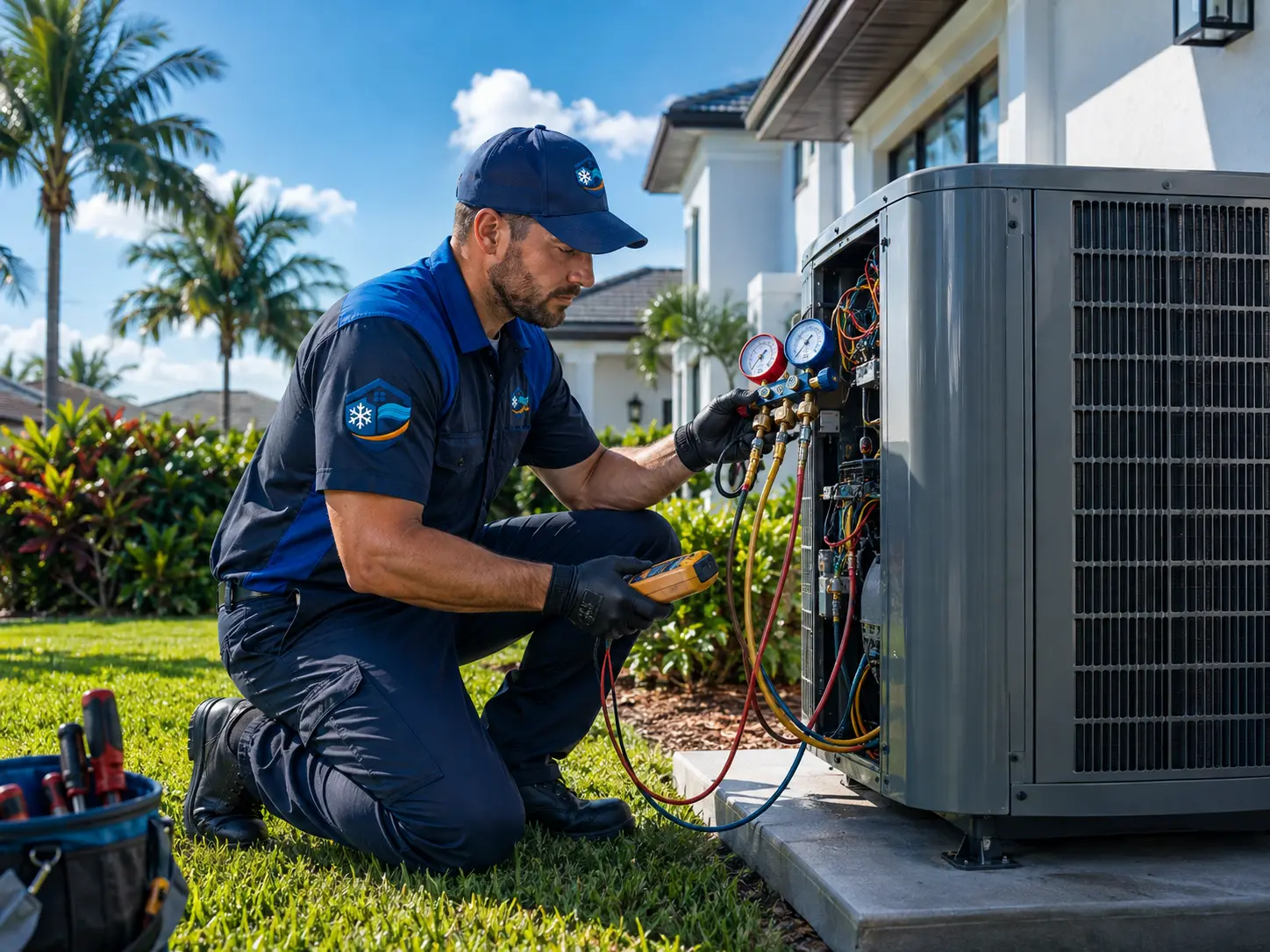
Field diagnostics
Pressures, temperature split and electrical values tell you which part failed. Symptoms alone don't.
System reference
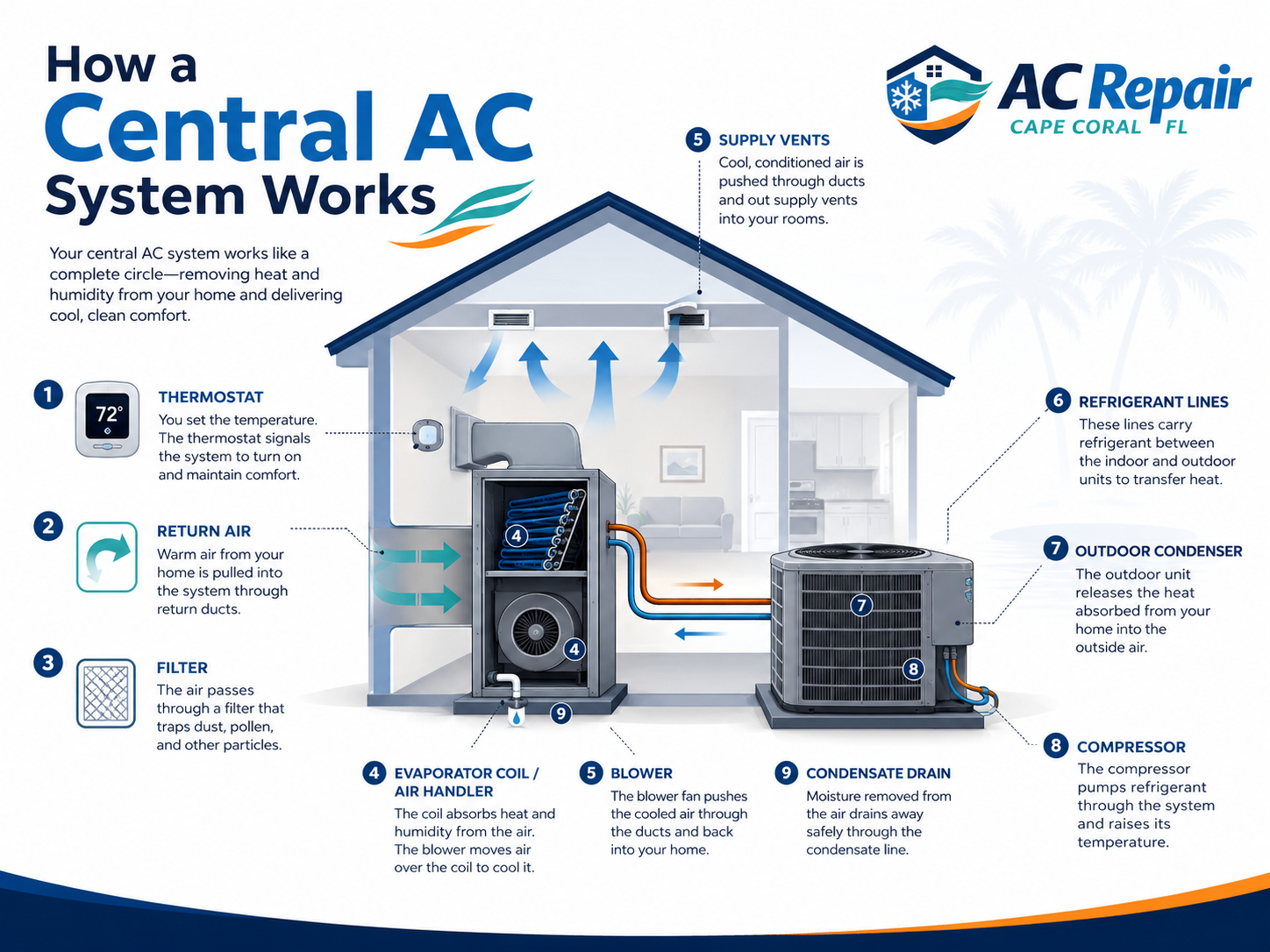
How a central AC system works
Understanding the loop makes repair decisions much easier. Your thermostat closes a low-voltage circuit calling for cooling. Warm indoor air is pulled through return ducts, passes the filter, and crosses the evaporator coil, where refrigerant absorbs both heat and moisture. The blower pushes that cooled, dehumidified air back through the supply ducts.
On the other side of the loop, the compressor in the outdoor unit raises refrigerant pressure and temperature so the condenser coil can release the collected heat into outdoor air. Moisture that condensed on the indoor coil drains away through the condensate drain. Every symptom on this site traces back to one of these stages failing.
Read the full system walkthrough for what each component does and how its failure presents.
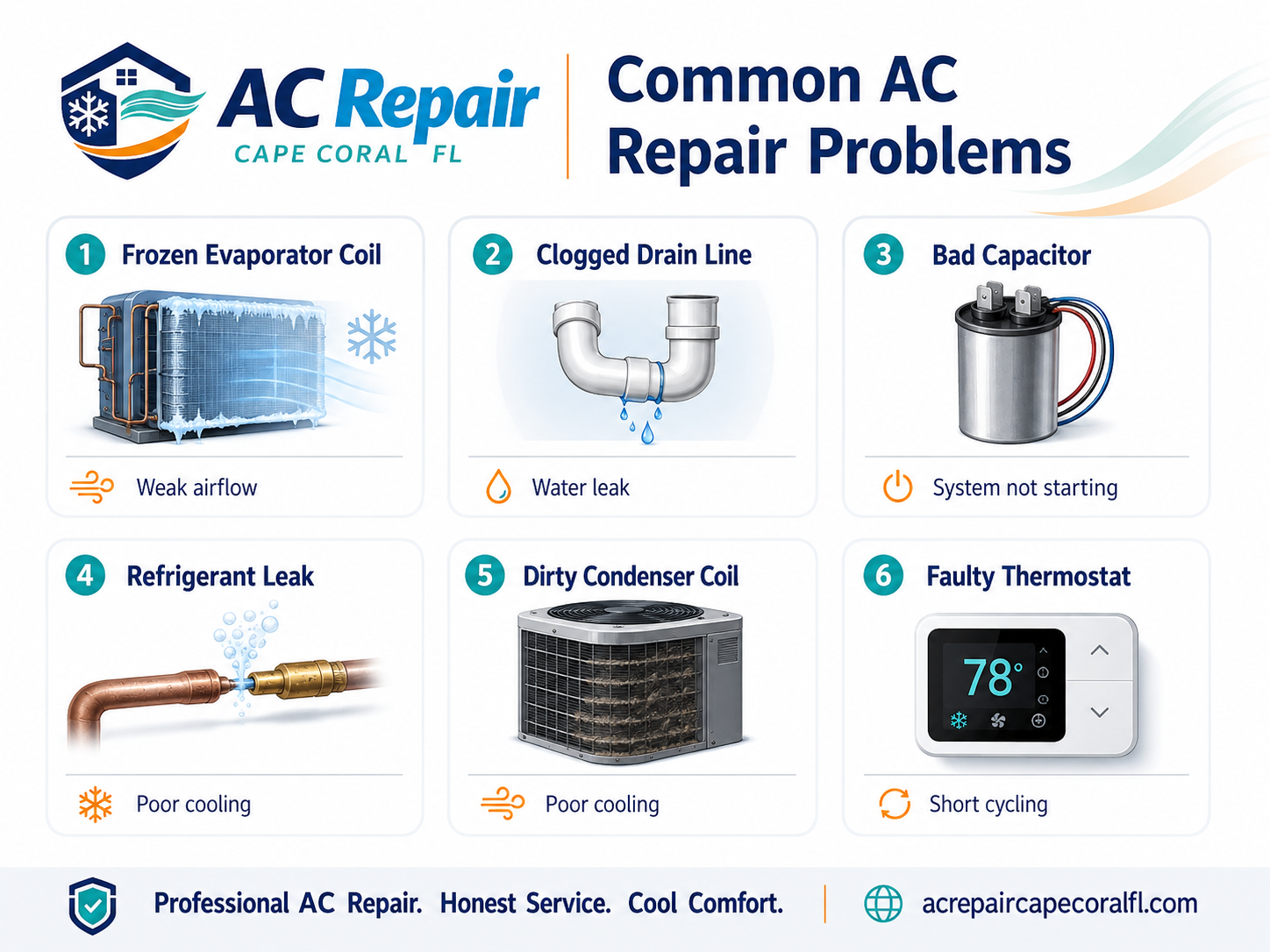
Failure map
Common AC repair problems
Each of these has a distinct symptom signature. Follow the one that matches your system.
- Frozen evaporator coilWeak airflow, ice on the coil or line set
- Clogged drain lineWater at the air handler, float switch trips
- Bad capacitorHumming, hard starting, fan won't spin
- Refrigerant leakGradual cooling loss, repeat recharges
- Dirty condenser coilPoor cooling, high runtime, high pressures
- Faulty thermostatShort cycling, blank display, wrong readings
Working through it yourself? The homeowner troubleshooting guide walks each symptom in order.
Decision framework
Repair or replace?
Age by itself is a weak signal. A twelve year old system with a failed capacitor is a routine repair. A nine year old system with a leaking evaporator coil and rising energy use is a genuine decision. The factors that actually matter are the failed component, how often the system has needed attention, and what the repair buys you in remaining service life.
Compressor condition is usually the deciding factor, because a compressor replacement approaches a meaningful share of replacement cost. Coil condition matters next: a leaking evaporator or heavily corroded condenser can undermine an otherwise sound system. Refrigerant type is part of the picture too, since older systems using phased-down refrigerants get progressively more expensive to service.
Comfort and operating cost belong in the calculation. If the house never quite reaches setpoint on hot afternoons, humidity stays high, or electric bills have climbed year over year while usage stayed flat, the equipment is telling you something a single part swap won't resolve.
Weigh these eight
- 01System ageRelative to expected service life under heavy Florida runtime.
- 02Repair frequencyTwo or more failures in a season changes the math.
- 03Compressor conditionElectrical and mechanical health of the most expensive part.
- 04Coil conditionEvaporator leaks and condenser corrosion limit repair value.
- 05Refrigerant typeObsolete refrigerants raise the cost of every future repair.
- 06Energy consumptionRising cost at flat usage signals declining efficiency.
- 07Comfort problemsSetpoint misses and humidity complaints point past one part.
- 08Repair cost ratioRepair cost measured against replacement, not against zero.
Service sequence
How the AC repair process works
Five stages, in order. A thorough diagnostic process should follow each stage before moving to the next, and parts should be tested before they’re replaced.

01
Describe the symptom
What the system is doing matters more than the model number. Warm air with a running blower points somewhere very different than a system that will not start at all.
02
System diagnosis
A thorough diagnostic process should check electrical values, control signals, airflow, temperature split across the coil, drain condition and refrigerant circuit behavior in sequence, so the failed component is identified rather than assumed.
03
Problem explanation
Before approving a repair, homeowners should receive a plain explanation of which part failed, what caused it, and whether anything else in the system contributed — without jargon or pressure to decide on the spot.
04
Repair decision
Repair options are laid out with the tradeoffs, including cases where a repair is a short-term fix on an aging system and replacement deserves consideration.
05
System verification
A proper repair verification includes rechecking the system under load: supply temperature, drain flow, amp draw and cycling behavior, so the fix is confirmed rather than hoped for.
Area index
Cape Coral service areas
Cape Coral spreads across more than 100 square miles of canal grid, older waterfront blocks and newer western communities. Each area page covers the cooling conditions specific to that part of the city.
Pelican
Southwest Cape · canal grid
02Caloosahatchee
Southeast Cape · river and canal area
03Yacht Club
South Cape · older waterfront
04Trafalgar
Central Cape · established blocks
05Mariner
Mid Cape · central corridor
06Burnt Store
Northwest Cape · newer builds
07Diplomat
Northeast Cape · Del Prado side
08Hancock
North central · mixed housing
09Jacaranda
North Cape · established residential
10Entrada
Northeast Cape · newer residential community
11Sandoval
West Cape · planned community
12Cape Harbour
Southwest Cape · harbour district
Cost variables
AC repair cost factors
Any fixed price quoted before a diagnosis is a guess. What a repair costs depends on which component failed, how the system is built, and how much labor the access requires. A run capacitor and a compressor are both "AC repairs" and they are nowhere near the same job.
Refrigerant work is its own category. Sealed-system repairs involve recovery, leak location, repair, evacuation and recharge, and the refrigerant type your system uses affects material cost significantly. Attic and closet air handlers with tight clearances add labor time that a garage-mounted unit would not.
Warranty status can change the picture substantially: many systems carry parts coverage well past the first few years, which shifts the cost to labor. Ask about it before approving work.
Failed part
Capacitor, contactor, motor, coil or compressor
System type
Split system, packaged unit, heat pump, multi-zone
System age
Part availability and compatibility on older equipment
Diagnostic complexity
Intermittent faults take longer to isolate
Refrigerant
Type and quantity required after a sealed repair
Accessibility
Attic, closet and tight-clearance installations
Labor scope
Time on site and whether a second visit is needed
After-hours timing
Evening, weekend and holiday service differs
Warranty status
Parts coverage can shift cost to labor only
Service standards
What homeowners should expect
Clear problem explanation
What failed, why it failed, and what it affects — in plain language.
Repair options before decisions
Choices and tradeoffs laid out before any work is approved.
Cape Coral-focused information
Content written around local heat, humidity and coastal conditions.
Direct phone access
One number, answered by someone who can discuss the symptom.
Diagnostic-first approach
Testing before parts. No replacing components on a hunch.
01Why is my AC running but not cooling the house?
The blower can keep running while the cooling side has stopped working. Common reasons are a stopped outdoor unit, a failed capacitor, low refrigerant charge from a leak, a frozen evaporator coil, or airflow blocked by a loaded filter. If the outdoor fan is not spinning while the thermostat calls for cooling, the problem is usually electrical or refrigerant related and needs testing.
02Should I turn the system off if it is blowing warm air?
Yes. Running a system that is not cooling can freeze the indoor coil, flood the drain pan, and put extra load on the compressor. Switch the thermostat to off, leave the fan on for a while if there is visible ice, and have the system checked before running it again.
03Is water around the air handler an emergency?
It is urgent because of the property damage risk, not the cooling loss. Water usually means the condensate drain is restricted or the pan is overflowing. Shut the system off to stop producing condensate, then get the drain cleared and the safety switch checked.
04Why does my AC keep freezing up in Cape Coral?
Ice forms when the coil gets colder than it should, which happens with restricted airflow or a low refrigerant charge. A dirty filter, closed or blocked returns, a weak blower, a fouled evaporator coil, or a refrigerant leak are the usual causes. High humidity means Cape Coral coils handle a large moisture load, so airflow problems show up as ice quickly.
05Can a capacitor really stop the whole system?
Yes. A failed run capacitor can leave the compressor or condenser fan unable to start, so the system hums, trips, or blows warm air with the indoor blower still running. Capacitors hold a charge and sit inside energized equipment, so testing and replacement should be done by a technician.
06How long should an air conditioner run in Florida heat?
Long cycles are normal in Cape Coral summer conditions. On very hot afternoons a correctly sized system may run nearly continuously to hold setpoint and pull humidity out of the air. What matters more is whether the supply air is meaningfully cooler than the return air and whether indoor humidity stays controlled.
07Does salt air affect outdoor AC units here?
Coastal and canal-side air can accelerate corrosion on condenser coils, fins, cabinet fasteners and electrical contacts. Corroded coils reject heat less effectively, which shows up as reduced cooling and higher runtime before the system fails outright.
08What does an AC diagnostic actually involve?
A useful diagnostic checks the thermostat call, verifies voltage and control signals, measures temperature split across the coil, checks airflow and filter condition, inspects the drain and safety switch, and evaluates the refrigerant circuit and start components. The point is identifying the failed part rather than guessing at it.
09Is it worth repairing an older AC system?
It depends on the failure, not the age alone. A capacitor or contactor on a ten year old system is routine. A failed compressor or a leaking evaporator coil on an older system using an obsolete refrigerant is a different decision. Compare repair cost, expected remaining life, and current energy use before choosing. See the repair or replace guide for the full breakdown.
10Do you charge for information over the phone?
Describing symptoms over the phone is free. Call 239-423-5617, explain what the system is doing, and you will get a straight answer about what the likely causes are and whether the situation needs same-visit attention.
11What information helps most when I call?
The thermostat setting and current indoor temperature, whether the outdoor unit is running, whether the indoor blower is running, any ice or water you can see, and whether a breaker has tripped. Those five points narrow the likely failure considerably.
12Which parts of Cape Coral does the site cover?
Information is published for areas across the city including Pelican, Cape Harbour, Yacht Club, Caloosahatchee, Trafalgar, Mariner, Hancock, Diplomat, Jacaranda, Burnt Store, Entrada and Sandoval.
Cape Coral, FL
Your AC shouldn't be a guessing game.
Describe what the system is doing and get a straight explanation of what needs to happen next.